“The Mind of the Maker”
This sermon was given at Trinity Cathedral in Porland, Oregon on Wednesday, December 17, 2025 on the Feast of Dorothy L. Sayers,
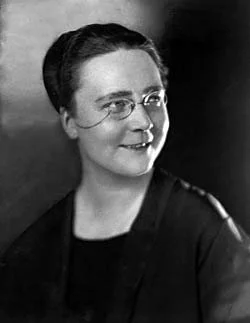
Dorothy L. Sayers
Lessons:
I Corinthians 12: 4-11
John 21:1-9
The pace of Advent is quickening. And as we gather tonight, we’re poised midway between, I believe, two of the most beautiful Sunday Collects of the Church Year.
Last Sunday we heard those words: “Stir up your power, O Lord, and with great might come among us.”
In a few more days on the Fourth Sunday in Advent we will pray: “Purify our conscience, Almighty God, by your daily visitation, that your Son Jesus Christ, at his coming, may find in us a mansion prepared for himself.”
These ancient prayers can be traced back to the eighth century and are like highly polished stones one might collect from a streambed,
A Guide for Times Like These
As we approach the Great Feast of the Nativity, I can think of no better guide for this liminal time than the person we are remembering on this night—Dorothy Leigh Sayers.
Like some of the saints recorded in our church calendar she led—shall we say—a complex and tangled life, especially in her youth.
She was born in 1893, at the end of the Victorian age, in Oxford to the Chaplain of the Choir School at Christ Church Cathedral. She was a student of medieval literature at Somerville College, Oxford, and one of the first women to graduate from that university. She then spent some years as a copywriter in the advertising field.
And if Sayers is known at all today, she is perhaps most commonly remembered for her detective fiction featuring that amateur sleuth, the wealthy Lord Peter Wimsey.
That was how I was introduced to her many years ago during one summer reading binge where I worked my way through such titles as Whose Body? and The Nine Tailors. The latter, besides being a remarkable example of detective fiction, is also a fascinating introduction to campanology or the study of bells and church bell ringing.
Eventually Sayers even wrote her way into her fictional stories in the character of Harriet Vane, as a love interest who eventually married Lord Peter.
Some of you may also recognize her name as one of the friends of C.S. Lewis, although she was not a member of that famous circle around Lewis known as the Inklings.
But Sayers found her way onto our Episcopal calendar of commemorations and is included in that liturgical book known as Lesser Feasts and Fasts principally for her spiritual writings and for her role as a Christian apologist.
Sayers wrote religious plays initially following in the steps of T. S. Eliot with a commission from Canterbury Cathedral for a play known as The Zeal of Thy House. Later she wrote an entire play-cycle for the BBC, The Man Born to be King, which was presented during the war years of 1941 and 1942.
As a writer, Sayers saw the religious life of the England of her time as lacking in intellectual fiber and so she became a fierce champion of the relevance of what she referred to as dogma and doctrine.
One of her books, The Mind of the Maker, stands particularly well, I believe, the test of time and offers us, especially in this Advent season, some unique spiritual insights.
Her exploration, of course, deserves more than a brief homily can capture, but I want to share a few of her thoughts that focus on the doctrine that gives this Trinity Cathedral its name.
The Trinity
“I suppose,” she writes, “that of all Christian dogmas, the doctrine of the Trinity enjoys the greatest reputation for obscurity and remoteness from common experience.” [1]
Sayers tackles this challenge by drawing from her belief that “all language about everything is analogical; we think in a series of metaphors.”[2]
“. . . (W)hen we speak of something of which we have no direct experience,” she writes, “we must think by analogy or refrain from thought. It may be perilous, as it must be inadequate, to interpret God by analogy with ourselves, but we are compelled to do so; We have no other means of interpreting anything.” [3]
Recall that our Psalmist today spoke poetically of the glory of God by referring to the heavens and the earth becomes a display of God’s handiwork.
Sayers then takes her experience as an artist, to speak about the Trinity:
“For every work [or act] of creation is threefold, an earthly Trinity to match the heavenly. First, [not in time, but merely in order of enumeration] there is the Creative Idea, passionless timeless beholding the whole work complete at once the end and the beginning: and this is the image of the Father.
Second, there is the Creative Energy [or activity] begotten of that idea, working in time from the beginning to the end, with sweat and passion being incarnate in the bonds of matter: and this is the image of the Word.
Third there is the Creative Power, the meaning of the work and in its response in the lively soul: and this is the image of the indwelling Spirit.
These three—Creative Idea, Creative Energy, Creative Power—are one, “each equally in itself the whole work, whereof none can exist without other: and this is the image of the Trinity.”[4]
So, for Sayers the Trinity is seen through the lens of the creative artist and the creative work of the artist in turn is seen as a trinity.
They inform each other.
“In the metaphors used by the Christian creeds about the mind of the maker, the creative artist can recognize a true relation to his own experience.” [5]
And, while Sayers in her book is largely focused on the creative work of the artist, what pertains to the artist can be applied to each of us as well.
Whatever may be our vocation or the work we most deeply feel called to do, if it is done with integrity, as an offering for God, and by the standard of eternity, we too are makers.
In the reading from Paul’s first Letter to the Corinthians that we heard a few moments ago, our work as people of faith was described using the language of “gifts,” gifts all activated by the one Spirit, the Creative Power of God.
To each of us has been given a manifestation of the Spirit—a gift, a calling; and this gift is given for the common good.
So then this Trinity Cathedral community becomes a community of the diversely gifted, called together to become the creative body of Christ bringing life to our world.
Sayers would have us see the Creed as capturing the mind of the Maker.
More than an abstraction, or an obscurity, or even a recitation we make following a sermon, we are invited to see the Trinitarian structure of the Creed as reflecting the fabric of reality, that world in which we live and move and have our being.
Alignment
As such it becomes a template for us to employ as a creative way of living—where Idea, Energy and Power are joined as one, in the work that we are called to do.
In this way we become aligned with the very shape of the universe like a body surfer fits their body to the curvature of the wave.
In this liminal time of the year our collects point us forward with urgency to prepare for this work of alignment, for this creative work that God seeks to do with us and within us.
Stir up your power and with great might come among us.
Make in us a fit mansion for the arrival of the coming Christ.
In 1868, Phillips Brooks, the renowned Rector of Trinity Church, Copley Square, in Boston, understood this internal work of incarnation with these words in the fourth verse of his beloved Christmas carol:
O holy Child of Bethlehem
Descend to us, we pray
Cast out our sin and enter in
Be born to us today
May it be so.
_________________________
Endnotes:
[1] Dorothy L. Sayers, The Mind of the Maker. (New York: HarperCollins Publishers, 1987), p. 35.
[2] Idem., p. 23.
[3] Ibid.
[4] Idem., pp. 37-38.
[5] Idem., p.45.