
Magnifica Humanitas
On Safeguarding the Human Person in the Time of Artificial Intelligence
A City & Spire Study Book for 2027
November 28, 2026
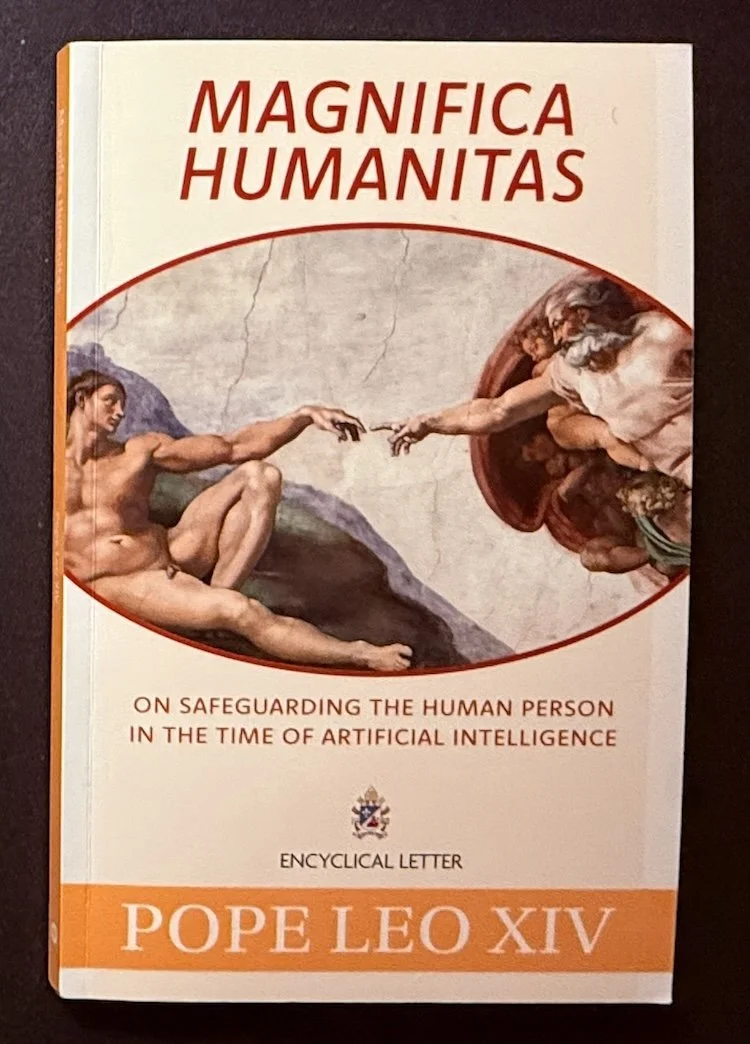
There is no better place to begin to engage current developments in robotics, artificial intelligence, and digital technology from an ethical and faith perspective than by reading and reflecting on Pope Leo’s first encyclical, Magnifica Humanitas (literally, magnificent humanity). The theme of this teaching document is “on safeguarding the human person in the time of artificial intelligence.” Released in May of 2026, the arrival of the encyclical could hardly be more timely.
In his discussion Leo draws upon two Biblical images: the construction of the Tower of Babel and the rebuilding of the walls of Jerusalem.
Babel, for Leo “reveals the limits of any effort that, however grandiose, arises from self-affirmation, sacrifices human dignity for efficiency, and aspires to reach heaven without God’s blessing.”
In the rebuilding of the walls of Jerusalem, “the city is reborn not through the initiative of one man, but through the shared responsibility of all . . . which rebuilds relationships before rebuilding with stones . . . when all persons assume their own role and recognize that their strength comes from the Lord.”
Applying these Biblical images to technology, Leo writes:
“In the abstract, technology in and of itself is not a solution to humanity's problems, just as it is not inherently evil. In practice, however, technology is never neutral, because it takes on the characteristics of those who devise, finance, regulate, and use it. Therefore, the primary choice is not between a ‘yes’ or ‘no’ to technology, but rather between constructing a Babel or rebuilding Jerusalem: between a power that claims to dominate the heavens and a people who work together in the presence of God to rebuild the walls of fraternal coexistence.”
Leo builds his encyclical on the foundation of Catholic Social Principles including the principle of the common good, the principle of the universal destination of goods (where the earth's goods are given by God to the entire human family with everyone having a right to these goods), and the principle of social justice.
Supported by these principals, Leo discusses the need to safeguard humanity during this digital transformation by rediscovering “truth as a common good,” by protecting “the dignity of work,” and by safeguarding “freedom against all forms of dependence and commercialization.”
Note: You can access this encyclical through the Vatican website.